
If you are deeply concerned about business growth and overall productivity, understanding the tools that can save time and streamline processes is very important, especially in this era of artificial intelligence. Whether you’re just starting with productivity tools or looking to enhance your operations, it’s essential to know the differences between automation, workflows, and AI agents.
By the end of this guide, you’ll have a clear understanding of what each term means and how they fit together.
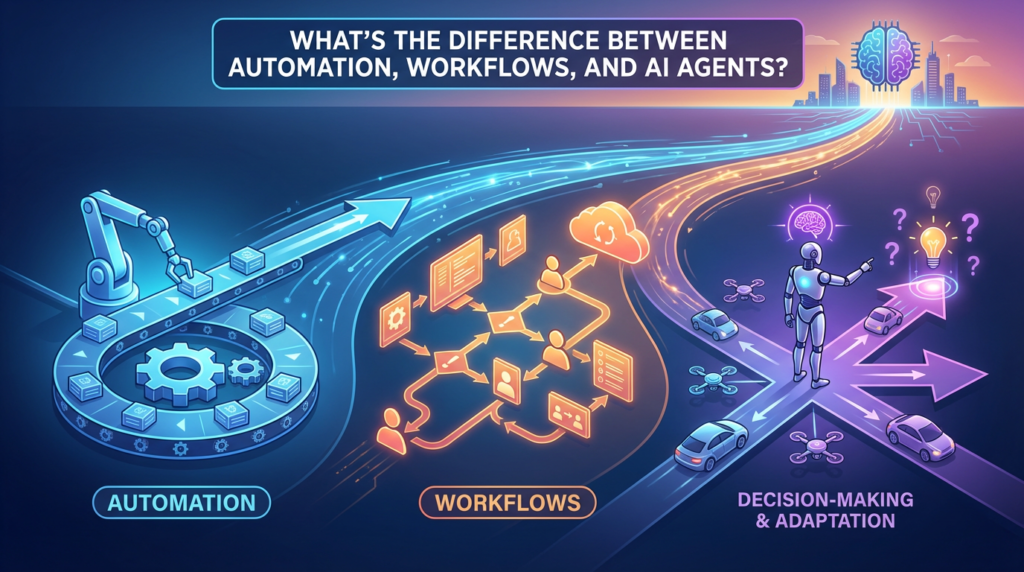
What is Automation?
Automation is any process in which tasks occur automatically without manual intervention. The main goal is to save time, reduce errors, and allow you to focus on more strategic work.
Simple Examples of Automation
- Email Rules: Automatically move all invoices to a specific folder.
- Form Submissions: When someone submits a Google Form, the data is automatically saved into Google Sheets.
- Database Actions: Sending a confirmation email to a customer when a record is updated in Notion.
The key point is that these tasks happen automatically. Automation is a set of specific actions performed in sequence to ensure tasks are completed consistently and efficiently.
What is a Workflow?
While automation involves actions that run automatically, a workflow is the structured sequence of steps that define how an automation works.
Think of a workflow as a recipe that guides your automation through triggers, actions, and decision points. Workflows often include:
- Triggers: The starting point, such as receiving an email or submitting a form.
- Actions: Steps that the system performs after the trigger, like sending notifications or updating databases.
- Nodes/Steps: Visual building blocks you connect to create the entire workflow.
A workflow is more than just automation; it organizes the actions logically to ensure processes run smoothly. Visually building workflows can make complex processes easier to manage and understand.
What is an AI Agent?
An AI agent is an innovative automation tool powered by artificial intelligence. Unlike standard automation or workflows that follow predefined rules, AI agents can:
- Analyze messages and understand language.
- Hold conversations and respond intelligently.
- Adapt to new information or changing situations.
Practical Examples of AI Agents
- Customer Support: An AI agent can read customer emails, understand the query, respond appropriately, or route it to the right team member.
- Intelligent Decision-Making: Agents can analyze data and choose the next step in a workflow based on insights rather than predefined rules.
In essence, AI agents think and act like humans, making them game-changing tools for businesses. They take standard workflows and automation to the next level by adding decision-making and adaptability.
Automation vs. Workflows vs. AI Agents: Quick Summary
| Feature | Automation | Workflow | AI Agent |
| Definition | Tasks that happen automatically | Sequence of connected steps guiding automation | Smart system using AI to make decisions |
| Complexity | Simple rules | Multiple actions and triggers | Advanced analysis, decision-making, and conversation |
| Example | Moving emails to a folder | Processing form submissions through multiple steps | Reading emails and responding intelligently |
Understanding these differences is essential, especially when building automations or implementing AI tools in your business.
The Clear Difference
Now that you know the distinctions:
- Automations handle tasks automatically.
- Workflows organize these tasks into structured sequences.
- AI Agents bring intelligence, adaptability, and decision-making into the mix.
Ready to see real results before exploring advanced automation? Grab your free copy of “The 15-Point Traffic Boost Checklist.” It’s the fastest way to implement high-impact fixes that increase your traffic this week with no tech skills needed.
Stay tuned, because understanding this system and the tools is just the beginning of boosting productivity and business growth
